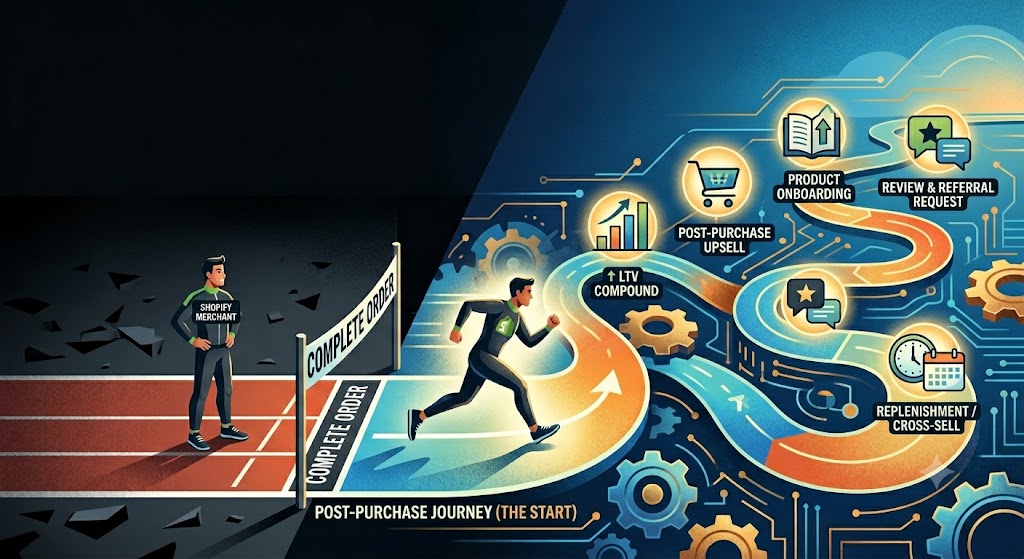
Brands spend enormous energy getting customers to the checkout. Ads, SEO, content, influencers — the entire acquisition machine is pointed at a single goal: getting someone to press "Complete Order." And the moment they do, most stores essentially disappear.
The confirmation email goes out. The Shopify fulfillment notification fires. And then — silence. The customer is left alone with their purchase, their tracking number, and no particular reason to come back.
I've built and optimised over 100 Shopify stores across 13 years. The single most consistent gap I find — across DTC brands big and small, across categories, across price points — is what happens (or doesn't happen) in the window after someone buys for the first time.
The post-purchase period is the warmest your customer will ever be. They've just made a decision. They're still excited about it. And you've done nothing with that moment except send them a receipt.
The gap after the checkout nobody talks about
There's a strange cultural assumption baked into most ecommerce operations: that getting the sale is the job, and everything after is logistics.
Fulfilment confirms the order. Shipping sends the tracking. Customer support handles problems. These things are treated as separate from "the business" — back-office functions rather than revenue functions.
That's exactly backwards.
Acquiring a new customer costs five times more than retaining an existing one. But most Shopify stores invest 95% of their marketing budget on acquisition and practically nothing on what happens after.
The economics of DTC ecommerce have shifted dramatically. Paid acquisition costs are up. iOS changes have wrecked attribution. The brands that win long-term aren't the ones who acquire the most customers — they're the ones who keep them longest, spend the least serving them, and turn them into advocates who bring others in.
All of that starts with what you do in the 24 hours after someone buys.
What's silently costing you
Most Shopify stores have three specific leaks in the post-purchase window. They're not dramatic — they don't show up as obvious failures on any dashboard — but they compound quietly over months and years into a significant revenue gap.
The upsell window left open. The thank-you page is statistically the highest-converting moment in the customer relationship. Someone who just bought is in a yes-state — their objections are down, their trust is briefly at its highest, their wallet is open. A well-placed post-purchase offer on that page (not a pop-up, not an email, on that page, before they navigate away) converts at rates most acquisition campaigns would envy. Most stores show nothing except "Your order is confirmed."
The onboarding silence. A customer who gets the product and isn't sure how to use it, what to expect, or how to get the most from it is a customer who's already halfway to returning it or not buying again. The best brands treat the first purchase like the start of a relationship — with a sequence of emails that answers questions before they're asked, builds confidence in the purchase, and introduces what's coming next.
The review and referral moment missed. The window when a customer is most likely to leave a review or recommend you to a friend is right after they've received the product and had a positive experience. Most brands ask for reviews too late, too generically, or not at all. The best brands hit that window with precision — and turn happy customers into an acquisition channel that costs almost nothing.
The post-purchase flow that actually works
I want to be specific about what this looks like in practice, because "send more emails" isn't a strategy. The sequence that works is one that respects the customer's emotional journey through the purchase and arrival.
Each step has a specific job. The confirmation handles logistics anxiety. The product email sets expectations and builds confidence. The review request captures the peak satisfaction moment. The cross-sell activates customers who are primed to buy again — not because you're pushing them, but because you've earned the next conversation.
None of this is complicated to build in Klaviyo or Shopify's native email. What makes it work isn't the technology — it's the timing, the tone, and the understanding that the customer is a person moving through an emotional journey, not a contact in a list waiting to receive your next campaign.
What 7 years at DYLN taught me
I built the Shopify Plus infrastructure for DYLN, a post-Kickstarter DTC brand, from the ground up and maintained it for seven years. Across that time — serving 300,000+ customers — the insight that most shaped how I think about post-purchase experience was this:
The customers who stayed longest and spent the most were the ones who felt educated and cared for after their first purchase. Not discounted. Not aggressively marketed to. Actually cared for — with content that helped them use the product better, feel better about the decision they made, and understand what else was available when they were ready.
The brands that treat every post-purchase touchpoint as a potential hard sell burn out their customer list fast. The ones that treat it as relationship infrastructure compound quietly for years.
In ecommerce, the compound effect of LTV is the whole game. And it starts — always — with what happens on the thank-you page.
Where to actually start
If your post-purchase experience is currently "order confirmation → tracking email → silence," the fastest wins are usually this order:
First: Add a post-purchase upsell to your thank-you page. Shopify Plus has native upsell blocks. Apps like ReConvert or Zipify handle this well for standard plans. Even a simple "Customers who bought this also love..." converts at 8–15% with zero additional ad spend.
Second: Build a 3-email onboarding sequence in Klaviyo triggered by purchase. Email 1: what to expect and when it arrives. Email 2: how to get the most from the product. Email 3: what others have discovered after their first month. These don't need to be long — they need to be genuinely useful.
Third: Wire up a timed review request. Not at 7 days (too early — the product might not have arrived). Not at 60 days (too late — the moment has passed). Somewhere between 12 and 18 days post-purchase, triggered dynamically by your average shipping time. Klaviyo handles this elegantly.
That's the foundation. Everything else — subscription nudges, cross-sell sequences, win-back flows — builds on top of it. But none of it matters if you're still treating the checkout as the end of the job.
The purchase is the start. The relationship — and the revenue that comes with it — is everything that happens next.

I've built Shopify and Shopify Plus stores for DTC brands across USA, Australia, and New Zealand — from post-Kickstarter launches to 300K+ customer operations. If your store's post-purchase experience is missing, I know exactly how to wire it up.
Ready to turn your checkout into the start of a relationship?
I build post-purchase flows, email sequences, and Shopify Plus systems that compound LTV over time — not just convert the first sale. Let's talk about what your store is leaving on the table.